Choosing a maternity centre for IVF only helps when it provides more than a convenient location. You need to verify the specialist’s training, the embryology laboratory, the pregnancy and emergency services, and whether the recommended treatment fits both partners’ diagnosis. By comparing those details, you can decide whether integrated care in Ravet offers a meaningful advantage over a standalone IVF clinic.
Key takeaways
- Confirm who provides antenatal care and delivery after a positive pregnancy test.
- Ask for the IVF laboratory’s registration and the clinic’s ART registration details.
- Compare live-birth reporting methods, itemised costs and included monitoring visits.
- Check whether your diagnosis and treatment history support IVF before committing.
What a maternity centre can add to IVF care
A maternity centre in Ravet can make IVF care more useful when one organisation coordinates stimulation, egg retrieval, embryo transfer, ultrasound monitoring, antenatal visits and delivery planning. That continuity helps if pregnancy complications arise, but the label proves nothing: some centres refer patients to an outside hospital after a positive test.
| Service | Why it helps | Confirm before choosing |
|---|---|---|
| Obstetric care | The IVF specialist can coordinate pregnancy follow-up with obstetric care | Ask whether an obstetrician manages high-risk pregnancies on-site |
| Anaesthesia | Retrieval can occur within the same hospital pathway | Confirm an anaesthetist, recovery area and emergency equipment are available |
| Emergency care | Sudden bleeding, severe pain or ovarian hyperstimulation syndrome needs rapid assessment | Ask whether emergency doctors and admission beds operate on-site |
| Neonatal care | Premature or unwell newborns need specialist support | Confirm a neonatal unit exists, or obtain the named referral hospital and transfer plan |
| Delivery services | Pregnancy care can continue through labour and caesarean planning | Check whether deliveries occur there and who covers nights and weekends |
Ask the IVF specialist for a written plan to reduce and detect OHSS, including medication dosing, trigger choice, follow-up and hospital admission arrangements. Confirm whether antenatal scans, blood tests, embryology, counselling and delivery are provided on-site or outsourced.
Request an itemised pathway covering medicines, monitoring, retrieval, anaesthesia, laboratory work, ICSI, freezing, storage, transfer and pregnancy testing. Also ask who remains responsible for your care after a positive result.
How to verify the specialist, laboratory and registrations
A maternity sign is not evidence of IVF competence. Verify the IVF doctor qualifications: an MBBS followed by MD, MS or DNB in Obstetrics and Gynaecology, plus documented training and experience in reproductive medicine and assisted reproduction.
| Person or service | Verify | Warning sign |
|---|---|---|
| IVF doctor | Named clinician, postgraduate qualification, fertility experience and who performs retrievals and transfers | A general gynaecologist presented as an IVF specialist without fertility training |
| Reproductive endocrinologist | Expertise in hormones, ovulation, ovarian reserve and stimulation planning | Treatment begins without reviewing both partners |
| Embryologist | Named laboratory professional, clinical embryology training and responsibility for culture, freezing and identification | No laboratory contact or explanation of embryo tracking |
| Laboratory | Written quality-control, witnessing, storage and equipment-maintenance procedures | Staff cannot explain what happens after egg retrieval |
Ask to see the ART clinic registration India requires under the Assisted Reproductive Technology (Regulation) Act, 2021, and confirm that any associated ART bank is registered separately. Check how the centre records consent, labels gametes and embryos, monitors liquid-nitrogen storage, retains treatment records and handles complaints.
- Request the clinic’s registration certificate or registration number, not a maternity or hospital licence alone.
- Ask who can access your records and how an identification error or storage failure is reported.
- Confirm whether the laboratory is on-site; an outside laboratory requires clear transport, custody and emergency arrangements.
A properly organised service answers these questions plainly and gives you the names of the responsible doctor, embryologist and laboratory contact.
How the team decides whether IVF is right for you
IVF should follow a cause-based assessment of both partners, not a woman’s scan alone. Review age, duration of infertility, previous pregnancies and treatments, ovulation, uterus and tubes, and male history. A semen analysis matters even when female tests are abnormal because male-factor infertility may be the only cause or may coexist.
| Option | What supports it | When it applies |
|---|---|---|
| Simpler treatment | Ovulation problems, usable tubes and adequate sperm | Timed intercourse, ovulation induction or intrauterine insemination |
| Surgery | A correctable blocked tube, fibroid, polyp or endometriosis | When the expected benefit outweighs surgical risk |
| IVF | Blocked tubes, severe male-factor infertility or failed simpler treatment | When fertilisation outside the body offers a clear advantage |
| Donor treatment | Very poor gamete prognosis or an inherited-disease concern | After discussing donor screening, consent and legal implications |
| No immediate treatment | Testing is incomplete, the couple needs time, or pregnancy remains reasonable without intervention | With a review date and safety-net plan |
Ovarian reserve testing helps predict response to stimulation, not egg quality. Interpret AMH and antral follicle count alongside age, because neither test reliably predicts an individual live birth; a low result does not automatically make IVF futile.
Ask for the reasoning in writing, including why an option was rejected, the complete cost pathway, and the plan for reducing ovarian hyperstimulation syndrome. If IVF is chosen, confirm how the team will adjust medication, monitor you and manage complications requiring hospital care.
What happens from consultation to early pregnancy
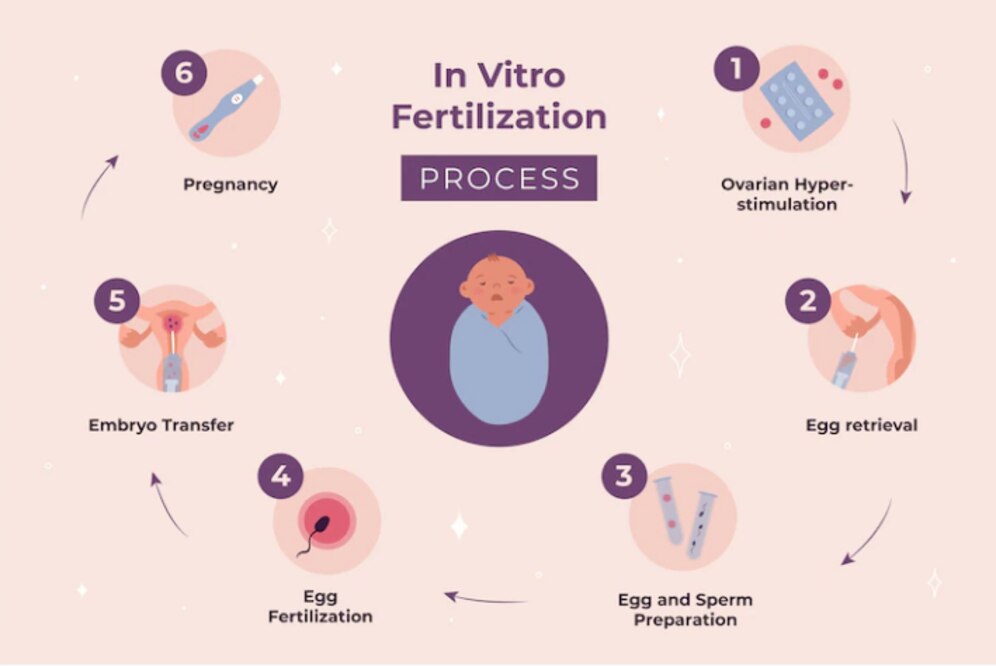
An IVF process timeline usually spans four to eight weeks for a fresh cycle, or longer when embryos are frozen for a later transfer. The specialist should give you a written estimate covering consultation, medicines, monitoring scans, anaesthesia, egg retrieval, laboratory work, ICSI if indicated, freezing, storage, transfer and pregnancy testing.
- Consultation and testing: review both partners, then complete ovarian reserve, uterine, tubal and semen assessments when relevant.
- Ovarian stimulation: daily gonadotrophin injections and ultrasound or blood-test monitoring usually continue for 8–14 days.
- Egg retrieval: the team collects eggs under sedation or anaesthesia about 34–36 hours after the trigger injection.
- Embryo culture: the laboratory fertilises suitable eggs and observes development for three to seven days before fresh transfer or freezing.
- Pregnancy testing: a blood test is usually scheduled about 9–14 days after transfer.
ICSI injects one sperm directly into an egg and is useful for severe male-factor infertility, very low sperm numbers or previous fertilisation failure. It is not automatically better than standard IVF, so ask what finding justifies the extra procedure.
A suitable embryo is usually transferred as a single embryo transfer to reduce twins, preterm birth and neonatal admission. Ask whether the centre freezes embryos and plans transfer later when stimulation has created OHSS risk.
The centre should explain individualised drug dosing, an antagonist protocol, trigger choice and warning symptoms such as rapid weight gain, severe abdominal swelling, breathlessness or reduced urination. Confirm who provides emergency assessment and hospital care if OHSS becomes severe.
How to compare results, costs and local continuity
Ask for written figures, not a promise of “high success.” Compare the IVF live birth rate using the same denominator—per embryo transfer, per egg retrieval, or cumulative outcome from one retrieval—and request breakdowns by age, diagnosis and use of own or donor eggs.
- What is included in the IVF treatment cost: medicines, scans, blood tests, egg retrieval, anaesthesia, ICSI, embryo freezing, storage, frozen transfer, cancellation and treatment of complications?
- Is PGT-A clinically indicated in my case, and is its biopsy, laboratory fee and counselling included or billed separately?
- Is the ART clinic and associated gamete bank registered under the Assisted Reproductive Technology Regulation Act 2021? How are consent, embryo identification, storage records and complaints handled?
- Are obstetricians, ultrasound, anaesthesia, neonatal care and emergency admission available on-site, or will you transfer me elsewhere?
- Who will monitor pregnancy after a positive test, and who coordinates delivery if the IVF doctor is unavailable?
Conceive IVF-IVF Centre, IVF Clinic in Hinjewadi, Wakad, Pune should answer these as service-specific questions rather than rely on its maternity label.
| Area | Compare | Warning sign |
|---|---|---|
| Outcomes | Own-egg live births by age and identical denominator | Pregnancy rate only or selected cases |
| Cost | Itemised quote through transfer and storage | “Low cost” package with exclusions |
| Support | Named on-site anaesthesia, neonatal and emergency teams | Verbal assurance about hospital backup |
| Continuity | Written plan from stimulation to delivery | Separate providers with no handover process |
Related service
IVF Consultant,IVF Specialist,IVF Doctor in Ravet,Punawale,Somatane Phata,PCMC,Pune IVF Consultant,IVF Specialist,IVF Doctor in Ravet,Punawale,Somatane Phata,PCMC,Pune ₹1000 Dr Madhuri Roy is a A Reliable and one of the Best IVF Consultant,IVF Expert,IVF Specialist,IVF Doctor in Ravet,Punawale,Kiwale,Somatane... |
Frequently asked questions
What can a maternity centre add to IVF care?
It can coordinate IVF treatment with ultrasound monitoring, antenatal care, pregnancy complication management and delivery planning. Ask whether these services happen at the same centre or through an outside hospital.
How can you verify an IVF specialist, laboratory and clinic registrations?
Ask for the doctor’s medical registration details, the IVF laboratory’s quality and safety information, and the clinic’s registration under India’s Assisted Reproductive Technology framework. Request copies or registration numbers you can verify.
How does an IVF team decide whether IVF is right for you?
The team reviews both partners’ medical history, ovarian reserve, semen analysis, tubal status, age, previous treatment and pregnancy goals before recommending IVF or another option.
What happens from the first consultation to early pregnancy?
Care usually includes fertility assessment, treatment planning, ovarian stimulation, monitoring, egg retrieval, fertilisation, embryo culture, transfer or freezing, a pregnancy test and early ultrasound follow-up.
How should you compare IVF results, costs and local continuity?
Compare the definition and time period behind reported results, request an itemised estimate, and confirm which medicines, tests, procedures, embryo storage and maternity services are included.