Male fertility concerns need more than a single semen report or an IVF referral. You will learn which clinician to consult, when to seek evaluation, how testing works, and how doctors match treatment to the underlying problem in both partners.
Key takeaways
- See an andrologist or reproductive urologist for persistent abnormal semen results.
- Repeat semen analysis after proper abstinence and follow the laboratory’s collection instructions.
- Check for varicocele, hormonal disorders, infections, medicines, and genetic causes.
- Ask about sperm retrieval and IVF or ICSI when sperm counts are extremely low.
Which doctor should you see for a male fertility problem, and when?
Start with a male fertility specialist, andrologist, or reproductive urologist rather than treating a semen report in isolation. A pregnancy doctor in Pimpri may coordinate care for both partners, but persistent or severe male-factor findings need a clinician experienced in male reproductive surgery, sperm retrieval, and genetic evaluation.
| Clinician | Best role | When to choose |
|---|---|---|
| Fertility or IVF specialist | Assesses both partners and coordinates treatment | When pregnancy has not occurred after the recommended interval |
| Andrologist | Focuses on sperm production, hormones, and male reproductive health | When semen results, hormones, or testicular findings are abnormal |
| Reproductive urologist | Treats structural problems and performs male fertility surgery or sperm retrieval | When there is varicocele, obstruction, absent sperm, injury, or prior surgery |
| Obstetrician-gynecologist | Coordinates the female partner’s evaluation and referrals | When either partner needs linked care |
Begin evaluation after 12 months of regular unprotected intercourse. Start after 6 months when the female partner is 35 or older. Seek help immediately after testicular injury, undescended testes, testicular or pelvic surgery, chemotherapy, sexual or ejaculation problems, anabolic-steroid or testosterone use, or a known reproductive disorder.
Both partners need assessment at the start because male factors contribute to about half of infertility cases, alone or alongside female factors. The first assessment includes medical and sexual history, medication review, physical examination, and semen testing; an abnormal result usually requires repeat testing before conclusions are made.
What happens at the first male fertility appointment?
The first appointment combines a fertility medical history, a physical examination, and a plan for testing; it is not a review of one semen report alone. The doctor will ask about:
- Prior testicular injury, surgery, undescended testes, infections, chemotherapy, and previous pregnancies
- Prescription medicines, supplements, anabolic steroids, and testosterone, which can suppress sperm production
- Heat or toxin exposure, smoking, alcohol, and recreational drug use
- Sexual history, including erection or ejaculation problems, intercourse frequency, and pain
- How long you have tried to conceive and any earlier fertility test results
A testicular examination checks testicular size, tenderness, position, epididymis, and veins that could indicate a varicocele. The doctor may also examine the penis and look for signs of hormonal or reproductive problems.
Testing commonly begins with a semen analysis. If the first result is abnormal, arrange at least one repeat test, ideally about one month later, because sperm counts vary between ejaculates.
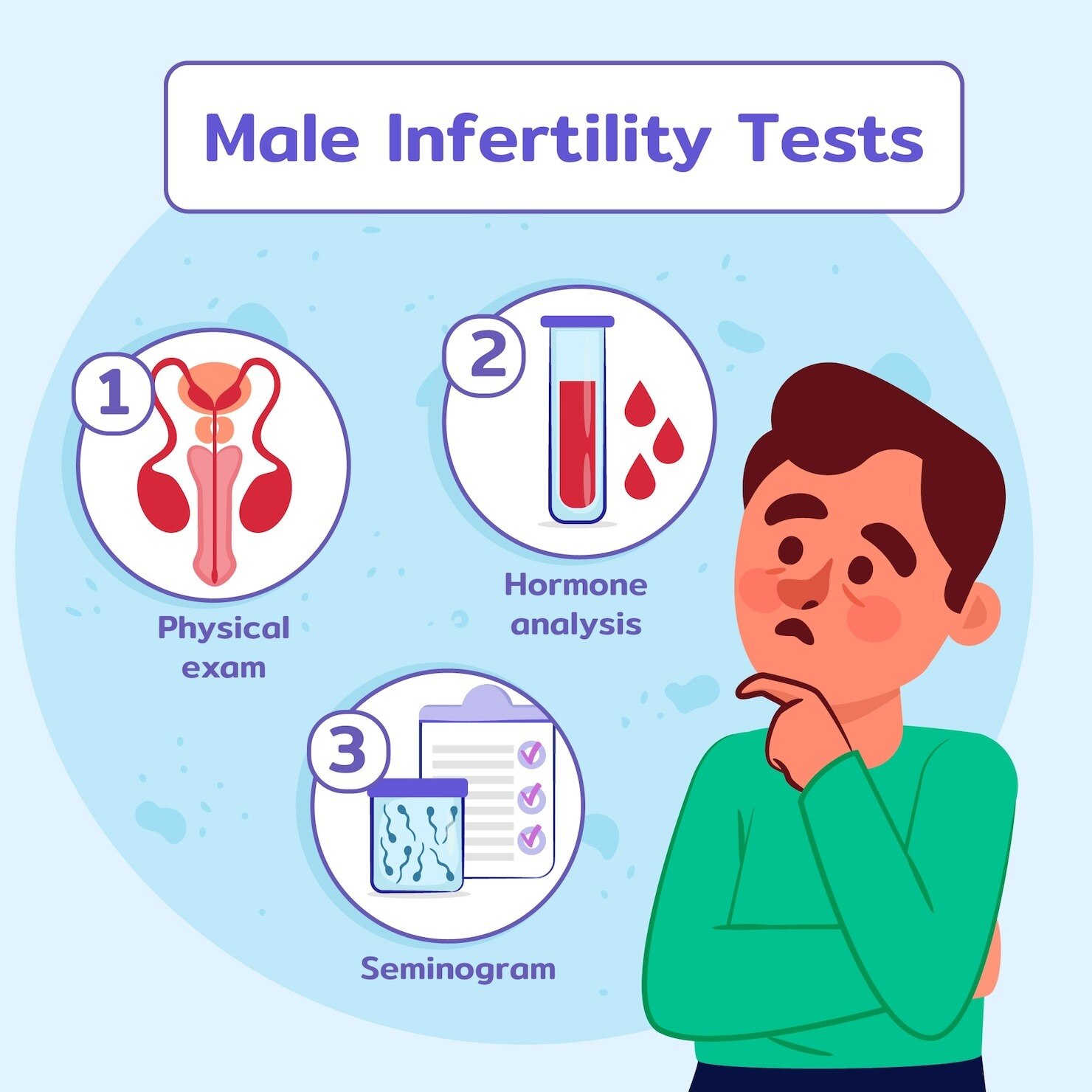
FSH and testosterone tests help assess hormone signals and sperm production; urine testing, infection tests, or scrotal ultrasound apply when symptoms or examination findings point to them. Genetic testing is reserved for severe cases such as azoospermia or very severe oligozoospermia with suspected impaired sperm production.
Both partners need assessment because male factors contribute to about half of infertility cases, alone or alongside female factors. Evaluating only the woman can delay the correct treatment for both people.
How should you prepare for and understand a semen analysis?
A valid semen analysis starts with semen analysis preparation: abstain from ejaculation for 2 to 7 days, wash your hands and penis, and collect the entire ejaculate in the laboratory’s sterile container. Do not use saliva, lubricant, or a household container.
Keep the sample near body temperature and deliver it within one hour, recording any spillage, fever, illness, or medicines that could affect the result.
1. Volume measures the amount of semen; the 2021 WHO lower reference value is about 1.4 mL. Sperm concentration measures sperm per millilitre, while total sperm number counts the entire sample. Reference values are about 16 million/mL and 39 million per ejaculate.
2. Sperm motility measures movement. Total motility includes all moving sperm, while progressive motility counts sperm moving forward effectively; reference values are about 42% and 30%, respectively.
3. Morphology describes sperm shape and structure. The lower reference value for normal morphology is about 4%, assessed using strict laboratory criteria.
4. Ask the laboratory whether it reports vitality, white blood cells, and agglutination. These findings can add context but do not independently prove fertility or infertility.
These figures are population reference limits, not a pass-or-fail boundary. Because results vary between ejaculates, an abnormal first analysis needs confirmation with a second test, ideally about one month later. Persistent abnormalities guide further assessment, such as hormone testing or specialist review.
What causes male fertility problems, and which treatments address them?
A varicocele, hormone disorder, blocked sperm pathway, infection, medication, or sexual problem can reduce fertility in different ways. The treatment depends on whether sperm production is impaired, sperm transport is blocked, or intercourse and ejaculation are affected.
| Cause or finding | Treatment that addresses it | When it applies |
|---|---|---|
| Varicocele | Varicocele treatment, usually microsurgical repair or embolisation | Consider when a palpable varicocele accompanies abnormal semen results or infertility |
| Low or abnormal hormone signals | Hormone testing FSH testosterone, followed by targeted treatment | Use for azoospermia, very low sperm concentration, low libido, testicular changes, or endocrine symptoms; never use testosterone replacement while trying to conceive |
| Obstruction | Reconstructive surgery, or surgical sperm retrieval from the epididymis or testis with IVF or ICSI | Applies when sperm are produced but cannot enter the semen, including some cases of azoospermia |
| Infection or inflammation | Appropriate antibiotics after examination and indicated urine or semen tests | Treats a confirmed infection; antibiotics do not restore fertility when no infection exists |
| Medicines, anabolic steroids, or testosterone | Review with the prescribing clinician and stop or replace the offending drug safely | Testosterone can suppress sperm production; recovery requires specialist monitoring |
| Erectile or ejaculation dysfunction | Treat the underlying condition, use sexual-medicine treatment, or retrieve sperm when ejaculation remains impossible | Applies to erectile dysfunction, retrograde ejaculation, or anejaculation |
Prior testicular injury, undescended testes, chemotherapy, and genetic conditions can permanently reduce sperm production. Severe azoospermia or oligozoospermia may require genetic testing and counselling before retrieval or assisted reproduction.
How do you choose fertility care in Pimpri when male-factor infertility is severe?
Choose a fertility clinic in Pimpri that can involve an andrologist or reproductive urologist when sperm production, blockage, varicocele, ejaculation, or testicular problems remain unexplained. A general obstetrician-gynaecologist can coordinate care, but severe oligozoospermia or azoospermia needs expertise in male reproductive surgery, sperm retrieval, and genetic evaluation.
ICSI injects one sperm directly into an egg, so it can help when sperm numbers or motility are extremely low, or when surgically retrieved sperm is used. IVF for male infertility does not repair the underlying cause, and ICSI is not automatically better than conventional IVF when enough motile sperm is available.
Ask the clinic to explain these points before choosing:
- Whether both partners are assessed and whether the male specialist reviews the examination, hormones, and semen results rather than relying on one report.
- Whether karyotype and Y-chromosome microdeletion testing are offered when azoospermia or severe oligozoospermia suggests impaired sperm production.
- Whether genetic counselling for male infertility happens before IVF or ICSI, including the possibility that a Y-chromosome deletion can pass to sons.
| Option | What to verify | When it fits |
|---|---|---|
| Andrologist or reproductive urologist | Surgery and sperm-retrieval experience | Azoospermia, severe counts, obstruction, or testicular findings |
| IVF specialist with male-factor support | Clear IVF versus ICSI reasoning | Assisted reproduction is recommended |
| Clinic with genetics access | Named counsellor and test pathway | Severe production failure or abnormal karyotype |
Conceive IVF-IVF Centre, IVF Clinic in Hinjewadi, Wakad, Pune is one local option to compare on these specific capabilities, not on location alone.
Related service
Male Infertility Treatment Centre Male Infertility Treatment Centre in Pimpri,Bhosari,PCMC,Pune Conceive IVF,Fertility And Test Tube Baby Center is the Best Male Infertility Treatment Centre in Pimpri,Bhosari,Alandi,Charholi,PCMC and Pune. |
Frequently asked questions
Which doctor should you see for a male fertility problem?
Start with an andrologist, male fertility specialist, or reproductive urologist. A pregnancy doctor can coordinate care for both partners, while severe findings need expertise in male reproductive surgery, sperm retrieval, and genetic evaluation.
What happens at the first male fertility appointment?
The clinician reviews your fertility history, sexual and medical conditions, medicines, surgeries, lifestyle factors, and previous test results. They may perform a physical examination and order semen analysis, hormone tests, ultrasound, or genetic testing.
How should you prepare for a semen analysis?
Follow the laboratory’s abstinence instructions, usually avoiding ejaculation for two to seven days. Collect the entire sample in the supplied sterile container, record the collection time, and deliver it within the laboratory’s stated time and temperature limits.
Which treatments address male fertility problems?
Treatment depends on the cause and can include correcting medicines or hormone disorders, treating infection, varicocele repair, sperm retrieval, or assisted reproduction such as IVF with ICSI.