The right fertility treatment depends on more than a pregnancy goal: age, ovarian reserve, ovulation, fallopian-tube health, uterine findings, sperm results and the time spent trying all change the decision. By comparing each option and understanding the tests, timelines, risks and costs involved, you can have a more productive treatment discussion with a fertility specialist in Pimpri.
Key takeaways
- Start with both partners’ fertility assessments, not IVF by default.
- Choose treatment based on ovulation, tubal, uterine and sperm findings.
- Ask the clinic to explain IVF risks, success measures and total steps.
- Use ICSI, donor embryos or genetic testing only for clear indications.
Which female infertility treatment fits your diagnosis?
Treatment starts with the diagnosis, not automatically with IVF. Evaluate both partners at the same time: after 12 months of regular unprotected intercourse if the woman is under 35, after 6 months if she is 35 or older, and sooner for irregular periods, suspected tubal disease, endometriosis, prior pelvic surgery or male-factor risks.
Age, ovarian reserve, ovulation, tube damage, uterine findings, sperm results and infertility duration shape the choice; AMH and antral follicle count estimate egg yield, not egg quality or a guaranteed live birth.
| Option | When it fits | What changes the decision |
|---|---|---|
| Timed intercourse | Ovulation occurs, tubes are open and sperm results are reassuring | Age, duration of infertility or declining reserve may justify faster treatment |
| Ovulation induction | Anovulatory PCOS or another ovulation disorder | Confirm tubal patency and semen results first |
| IUI | Selected unexplained or mild male-factor infertility | A limited stimulation-with-IUI course; compare outcomes before IVF |
| IVF | Blocked or damaged tubes, severe endometriosis, failed lower-intensity treatment or severe male-factor infertility | Age, ovarian reserve and uterine health affect success |
| ICSI | Severe male-factor infertility, surgically retrieved sperm or prior failed fertilisation | It is not routinely superior to conventional IVF |
| Donor eggs or embryos | Severely diminished reserve, repeated unsuccessful cycles or inherited-risk concerns; embryo donation removes genetic contribution from both parents | Donor treatment does not remove recipient pregnancy risks |
| Gestational surrogacy | The intended parent cannot safely carry a pregnancy | Uses an embryo carried by another person; legal and medical assessment is essential |
| Fertility preservation | Eggs or embryos need freezing before reserve or egg quality declines | Time-sensitive, not a guarantee of future birth |
Endometriosis and uterine abnormalities require individual assessment rather than an automatic procedure. Ask for age-specific cumulative live-birth figures and the expected number of retrievals, not only pregnancy rates per transfer.
What happens during a female fertility assessment?
A female fertility assessment starts with your history and an evaluation of both partners. Discuss cycle length, bleeding, ovulation, pregnancy, contraception, prior pregnancies, infertility treatment, medical and surgical conditions, medicines, and family history. A pelvic ultrasound checks the uterus, ovaries and antral follicle count.
| Test | What it helps estimate | What it cannot prove |
|---|---|---|
| AMH test | Ovarian response and likely egg numbers | Egg quality or a guaranteed live birth |
| Antral follicle count | Follicle supply and expected response to stimulation | Embryo chromosome health |
| Day-3 FSH and estradiol | Ovarian-function context at the start of a cycle | The complete chance of pregnancy |
| Semen analysis | Sperm concentration, movement and shape | Every cause of infertility |
Age remains a major factor in embryo chromosome health. A high egg count does not ensure high-quality embryos: eggs can fail to mature or fertilise, and embryos can stop developing before blastocyst formation. Ask for the expected egg yield, likely number of retrieval cycles and age-specific cumulative live-birth data.
Hysterosalpingography or contrast ultrasound such as HyCoSy checks whether the fallopian tubes are open. Reserve hysteroscopy for suspected polyps, submucosal fibroids, adhesions, an abnormal uterine cavity or repeated implantation failure. Endometriosis does not automatically require surgery; removing an endometrioma can reduce ovarian reserve, so weigh pain, suspected malignancy and follicle access against that risk.
- Which findings change the treatment recommendation?
- What is the expected egg yield and number of cycles?
- Which age-specific cumulative live-birth figures apply to you?
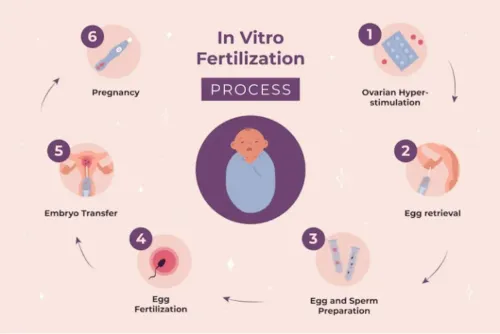
How does an IVF cycle work from injections to pregnancy testing?
An IVF cycle usually runs from 8 to 14 days of stimulation before egg retrieval, followed by embryo development, transfer and pregnancy testing.
1. Ovarian stimulation injections use recombinant FSH or human menopausal gonadotropin to grow several follicles. Ultrasound scans and blood estradiol tests guide dose changes across several clinic visits.
2. A GnRH antagonist or another suppression medicine prevents premature ovulation. When follicles reach the required size, an hCG or GnRH-agonist trigger injection completes egg maturation.
3. About 34 to 36 hours later, an ultrasound-guided egg retrieval removes eggs through the vagina under sedation. Pelvic discomfort, bleeding, infection, ovarian torsion and ovarian hyperstimulation syndrome are recognised risks.
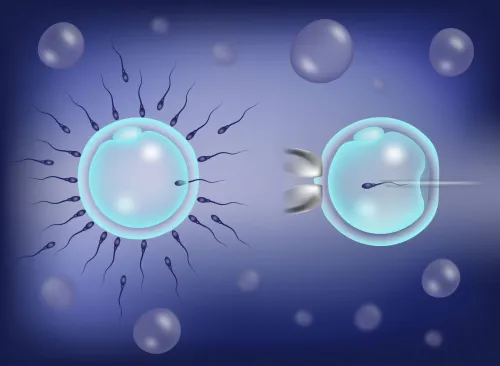
4. Mature eggs undergo conventional IVF or ICSI. In ICSI, one sperm is injected into each mature egg. Embryos are cultured to the cleavage stage or blastocyst stage.
5. Embryo grading describes appearance and development: a stronger grade usually means more evenly dividing cells and fewer visible fragments, but it cannot guarantee implantation or a live birth. Progesterone support prepares and maintains the endometrium.
| Transfer option | Timing | Endometrial preparation |
|---|---|---|
| Fresh embryo transfer | In the stimulation cycle | Transfer occurs when the lining and clinical conditions are suitable |
| Frozen embryo transfer | In a later cycle | Natural ovulation tracking, or estrogen followed by progesterone, prepares the lining |
Pregnancy testing is usually done 9 to 14 days after transfer. A positive result is followed by an ultrasound to confirm the pregnancy’s location and development.
When are ICSI, donor embryos or genetic testing useful?
ICSI adds value when sperm cannot reliably fertilise eggs without assistance; it is not automatically a better version of IVF. The main ICSI indications are severe male-factor infertility, surgically retrieved sperm, or a previous cycle with very low or absent fertilisation.
| Option | What happens | When it adds value |
|---|---|---|
| Conventional IVF versus ICSI | Prepared sperm is placed with eggs; ICSI injects one sperm into each mature egg. | Use ICSI for the indications above; routine use without male-factor infertility has not consistently improved live-birth rates and adds micromanipulation and cost. |
| Donor eggs | Eggs from a screened donor are fertilised with sperm and the resulting embryo is transferred to the recipient. | Consider severely diminished ovarian reserve, repeated cycles without usable embryos, or major inherited or age-related concerns. Recipient health and age-related pregnancy risks remain. |
| Embryo donation | An embryo created from donor egg and donor sperm is transferred. | Discuss it when neither intended parent will contribute genetic material. |
| PGT-A | Tests embryo chromosome copy-number differences. | Consider only after discussing whether its possible information outweighs biopsy, cost, and the risk of having no embryo to transfer. |
PGT-A cannot detect every genetic or developmental condition and has not shown a routine live-birth benefit for every patient. PGT for a known single-gene disorder or chromosomal rearrangement is a different medical indication.
The ICSI indications, donor options and testing plan should match your results, not a package. Egg or embryo freezing works best before ovarian reserve and egg quality decline, but stored eggs do not guarantee a future birth. Ask how many retrievals are expected and request age-specific cumulative live-birth data.
How should couples in Pimpri compare an IVF plan, risks and clinic quality?
A good-prognosis embryo is why many couples discuss single-embryo transfer. Transferring two or more embryos raises twin or higher-order pregnancy, preterm birth, hypertensive disease, gestational diabetes and neonatal intensive-care risks.
| Plan | What to compare | Why it matters |
|---|---|---|
| Embryo transfer | One versus two or more embryos | One embryo reduces multiple-pregnancy complications |
| PCOS protocol | Antagonist protocol, GnRH-agonist trigger and freeze-all plan | This combination supports OHSS prevention |
| Success data | Age-specific cumulative live-birth rate | Pregnancy rate per transfer can hide failed fertilisation, arrested embryos and repeat retrievals |
Egg retrieval commonly causes pelvic discomfort; bleeding, infection, ovarian torsion, ectopic pregnancy and ovarian hyperstimulation syndrome are important risks. Ask what happens after hours. Severe swelling or pain, rapid weight gain, vomiting, breathlessness, fainting or reduced urination requires urgent assessment.
Request IVF treatment cost inclusions in writing: consultations, medicines, monitoring, retrieval, anaesthesia, fertilisation method, embryo culture, storage, transfer, pregnancy testing and cancellation charges. Question add-ons such as endometrial scratching, intralipids, immune testing and platelet-rich plasma when evidence of improved live birth is unclear.
Before choosing a Pimpri provider, ask about ART regulation India, written consent, donor-gamete records, embryo-storage procedures and emergency access. Conceive IVF-IVF Centre, IVF Clinic in Hinjewadi, Wakad, Pune can help review these decisions, but compare its written plan and age-specific figures with other providers.
Related services
IVF Treatment Centre IVF Treatment Centre in Pimpri,Bhosari,PCMC,Pune Conceive IVF,Fertility And Test Tube Baby Center is the Best IVF Treatment Centre in Pimpri,Bhosari,Alandi,Charholi,PCMC and Pune. View service → |
IVF Centre,IVF Clinic in Pimpri,Bhosari,PCMC,Pune IVF Centre, IVF Clinic in Pimpri, Bhosari, PCMC, Pune ₹1000 Conceive IVF Fertility Centre is the Best IVF Centre, IVF Clinic, Infertility Centre, and Fertility Centre in Pimpri-Chinchwad, Bhosari, Alandi,... View service → |
Frequently asked questions
Which female infertility treatment fits your diagnosis?
Treatment depends on the cause. Ovulation problems may need medicines, while blocked tubes, endometriosis, reduced ovarian reserve or multiple factors may lead to surgery, IUI or IVF.
What happens during a female fertility assessment?
Assessment commonly includes menstrual and medical history, ovarian-reserve tests, ultrasound, ovulation review and tubal evaluation. Both partners need assessment because sperm factors can affect treatment choice.
How does an IVF cycle work from injections to pregnancy testing?
An IVF cycle usually involves ovarian stimulation injections, ultrasound and blood-test monitoring, egg retrieval, fertilisation in the laboratory, embryo culture, embryo transfer and a timed blood pregnancy test.
When are ICSI, donor embryos or genetic testing useful?
ICSI is useful when sperm cannot fertilise eggs reliably. Donor embryos may help when using a couple’s own eggs or sperm is unsuitable. Genetic testing requires a specific medical reason and counselling.
How should couples in Pimpri compare an IVF plan, risks and clinic quality?
Compare the diagnosis, alternatives, medication plan, monitoring, laboratory details, cancellation rules, complications, total costs and how the clinic reports outcomes. Ask who performs each step and what follow-up includes.
Related services
Low Cost IVF Centre in Pimpri,Bhosari,PCMC,Pune Low Cost IVF Centre in Pimpri,Bhosari,PCMC,Pune Conceive IVF,Fertility And Test Tube Baby Center is the Best Low Cost IVF Centre in Pimpri, Chinchwad, Bhosari, Alandi, Charholi, PCMC and Pune. |
Previous IVF Failure Treatment Centre Previous IVF Failure Treatment Centre in Pimpri,Bhosari,PCMC,Pune Conceive IVF,Fertility And Test Tube Baby Center is the Best Previous IVF Failure Treatment Centre in Pimpri,Bhosari,Alandi,Charholi,PCMC and Pune. |
IVF Treatment Centre in Bhosari IVF Treatment Centre in Bhosari,PCMC,Pune Conceive IVF,Fertility And Test Tube Baby Center is the Best IVF Treatment Centre in Bhosari, Dighi, Charholi, Alandi, PCMC and Pune. View service → |
IVF Counselling Centre IVF Counselling Centre in Pimpri,Bhosari,PCMC,Pune ₹1000 Conceive IVF,Fertility And Test Tube Baby Center is the Best IVF Counselling Centre in Pimpri,Bhosari,Alandi,Charholi,PCMC and Pune. View service → |