Yes. An obstetrician and gynecologist can start the evaluation of both partners, investigate common male factors, order semen testing and coordinate treatment, but complex conditions may require a male reproductive urologist or andrologist. You will be able to identify the doctor’s scope, prepare for the first appointment and know when specialist referral is necessary.
Key takeaways
- A gynecologist can start the male partner’s evaluation and coordinate both partners’ care.
- Choose an andrologist or urologist for testicular, hormonal, or surgical male-infertility problems.
- Bring prior semen reports, medication details, and both partners to the first appointment.
- Repeat abnormal semen results before drawing conclusions; testing conditions affect the report.
What an Obstetrician and Gynecologist Can Do for the Male Partner
An obstetrician and gynecologist in Nigdi can evaluate the male partner as part of a couple’s infertility work-up. The doctor can begin a male infertility evaluation, arrange semen testing, provide semen analysis interpretation, assess both partners together, and coordinate treatment rather than investigating only the woman.
The initial male-focused care may include:
- Reviewing fertility history, intercourse timing, erectile or ejaculatory problems, previous infections, surgeries, medications, heat or toxin exposure, and sexual health.
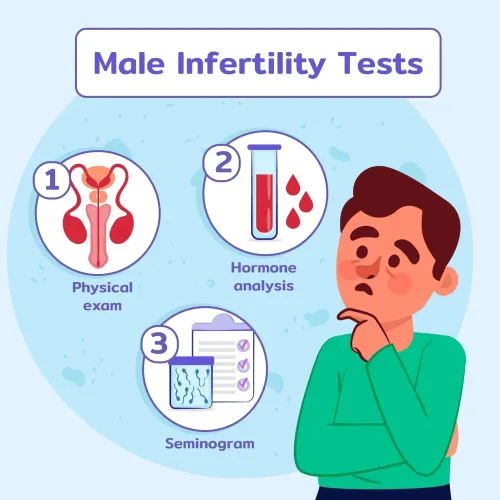
- Ordering a diagnostic semen analysis. Give the laboratory the entire ejaculate after 2–7 days of abstinence, using its clean container and delivery instructions.
- Examining for testicular abnormalities and discussing possible varicocele, obstruction, infection, medication effects, or hormonal disorders.
- Ordering FSH and testosterone when libido or erection problems, oligozoospermia, azoospermia, small testes, or other endocrine findings justify hormone testing.
- Treating appropriate infections or sexual-timing difficulties and coordinating assisted reproduction when necessary. Vitamins and antioxidants are not a proven cure.
An abnormal result does not automatically mean IVF. The doctor may repeat the semen analysis and explain the next step, but suspected varicocele, testicular disease, obstruction, azoospermia, or a need for surgery calls for referral to a urologist with male-reproductive expertise or an andrologist.
If IVF or ICSI is proposed, ask whether the facility is registered under India’s Assisted Reproductive Technology (Regulation) Act, 2021.
Which Specialist Should Handle Each Male-Infertility Problem?
The right specialist depends on the suspected problem, but an obstetrician and gynecologist can start the couple’s evaluation rather than sending the male partner away. This doctor reviews history, medicines and exposures, examines both partners, orders and interprets semen analysis, addresses timing or sexual difficulties, and coordinates treatment with male-reproductive specialists.
| Role | Main contribution | When to involve |
|---|---|---|
| Obstetrician and gynecologist | Starts concurrent evaluation, treats straightforward hormonal, infectious, medication-related or ejaculatory issues, and coordinates care | Initial assessment or combined fertility treatment |
| Reproductive endocrinologist | Manages reproductive hormones and assisted reproduction, including IUI, IVF and ICSI, while assessing both partners | Hormonal disorders, complex fertility planning or need for assisted reproduction |
| Urologist | Diagnoses and operates on male urinary and reproductive conditions, including obstruction, testicular disease and varicocele | Azoospermia, palpable varicocele, suspected obstruction or surgery |
| Andrologist | Focuses on male fertility, sperm production, sperm function and male reproductive testing | Persistent abnormal semen results, severe sperm deficiency or complex male-factor infertility |
Referral matters when semen results remain abnormal, sperm are absent, the testes are abnormal, or surgery is being considered. Varicocele treatment is not automatic: varicocelectomy is considered mainly for infertility with a palpable varicocele and abnormal semen parameters, not an imaging-only finding. Do not start testosterone for fertility; it suppresses sperm production.
Supplements are not a proven cure. ICSI can bypass severe sperm problems but does not correct their cause.
What Happens at the First Couple’s Infertility Appointment?
Expect a joint infertility assessment, with both partners evaluated during the same work-up rather than treating infertility as solely a woman’s problem. The clinician will ask about duration of trying, previous pregnancies, contraception, intercourse frequency and timing, erectile or ejaculatory difficulties, infections, surgeries and chronic illnesses.
The history commonly includes:
- Reproductive history, including puberty, pregnancies, miscarriages and previous fertility treatment
- Medication review covering testosterone, anabolic steroids, finasteride, antidepressants and other long-term drugs
- Lifestyle and exposure review covering smoking, alcohol, cannabis, heat, pesticides, radiation, occupational chemicals, recent fever and weight changes
- Family history of infertility, genetic conditions or early menopause
| Partner | Examination | Initial tests |
|---|---|---|
| Male partner | Testes, epididymis, penis, varicocele, body hair and other signs of hormonal or testicular disease | Semen analysis measuring volume, sperm concentration, motility and morphology; repeat testing is needed when the first result is abnormal |
| Female partner | General and pelvic examination when indicated, including signs of infection, uterine disease or hormonal disorders | Pregnancy test, ovulation assessment and targeted blood tests or pelvic ultrasound based on menstrual history and findings |
| Both partners | Review of sexual timing, fertility goals and previous treatment | The clinician orders further hormone, infection, imaging or genetic tests only when the history or initial results justify them |
A gynecologist can order and interpret the initial semen analysis and coordinate care. Azoospermia, severe oligospermia, testicular abnormalities or suspected obstruction warrant referral to a male reproductive urologist or andrologist.
Which Tests Explain Abnormal Sperm Results?
An abnormal semen analysis needs confirmation before it becomes a diagnosis. Obtain two semen analyses, ideally about one month apart, using an abstinence interval of 2–7 days and collecting the entire ejaculate. Record semen volume, sperm concentration and total count, motility, and morphology; a missed portion of the sample can falsely lower the result.
| Test | What it can explain | When it applies |
|---|---|---|
| Repeat semen analysis | Whether low count or poor motility persists | After an abnormal first result; follow the same collection instructions |
| Hormone tests | Problems with sperm production or testosterone regulation | Azoospermia, very low sperm concentration, reduced libido, erectile symptoms, small testes, or other signs of endocrine disease; tests often include morning testosterone, FSH and LH |
| Scrotal ultrasound | Testicular structure, obstruction clues, or a varicocele | Testicular pain, an abnormal examination, suspected mass, or an unclear scrotal finding; an imaging-only, nonpalpable varicocele is not treated automatically |
| Genetic testing | Inherited causes and whether sperm retrieval is sensible | Azoospermia or severe oligozoospermia with evidence of impaired sperm production; karyotype and Y-chromosome microdeletion testing are key examples |
| Post-ejaculatory urine test | Retrograde ejaculation, where sperm enters the bladder | Very low semen volume or absent ejaculate, especially after pelvic surgery, diabetes, neurological disease, or certain medicines |
Ask the clinician to interpret results alongside the physical examination and history. Hormone or genetic findings can change counselling and referral, while ultrasound alone should not trigger varicocele surgery.
How to Choose Male-Infertility Care in Nigdi
Before choosing a clinic in Nigdi, verify that it evaluates both partners and does more than arrange IVF. Ask who reviews semen results, who examines the man, and whether the clinic can refer directly to a male-reproductive urologist or andrologist.
- Confirm access to semen analysis, hormone assessment and male-factor history, including medicines, testosterone use, infections, surgery and occupational exposures.
- Ask what happens after two abnormal semen tests, suspected varicocele, testicular disease, ejaculatory difficulty or azoospermia.
- If IVF or ICSI is offered, ask for the facility’s registration details under the ART Regulation Act 2021 and the laboratory’s process for sperm identification, storage and consent.
- Do not start testosterone replacement while trying to conceive; it can suppress LH and FSH and sharply reduce sperm production.
| Care pathway | What to verify | When it applies |
|---|---|---|
| Obstetrician-gynecologist | Joint assessment, initial semen testing and coordinated referral | Abnormal results, timing problems or straightforward medication and hormonal review |
| Male-reproductive urologist or andrologist | Expertise in varicocele, obstruction, testicular disease, surgery and sperm retrieval | Persistent abnormalities, suspected obstructive azoospermia or azoospermia without a clear cause |
| ART centre | Registered services, embryology laboratory and documented ICSI counselling | Very low sperm numbers, failed insemination or sperm retrieval planned for ICSI |
A clinic such as Conceive IVF-IVF Centre, IVF Clinic in Hinjewadi, Wakad, Pune is worth assessing by these questions rather than its location or title alone. ICSI can overcome severe sperm shortage, but it does not diagnose or cure the underlying male condition.
Related services
Male Infertility Treatment Centre in Nigdi,Akurdi,Chinchwad,PCMC,Pune Male Infertility Treatment Centre in Nigdi,Akurdi,Chinchwad,PCMC,Pune Conceive IVF,Fertility And Test Tube Baby Center is the Best Male Infertility Treatment Centre in Nigdi,Akurdi,Chinchwad,PCMC and Pune. |
Male Infertility Treatment Centre Male Infertility Treatment Centre in Hinjewadi,Wakad,PCMC,Pune Conceive IVF,Fertility And Test Tube Baby Center is the Best Male Infertility Treatment Centre in Hinjewadi,Maruji,Mahalunge,Kasarsai,Nerhe,PCMC and... View service → |
Frequently asked questions
Can a gynecologist in Nigdi evaluate male infertility?
Yes. A gynecologist can assess both partners, arrange semen analysis, interpret initial results, and coordinate further male-infertility care.
Which specialist treats male-infertility problems?
A gynecologist can begin the work-up, while an andrologist or urologist handles testicular, hormonal, obstructive, and surgical problems.
What happens at the first couple’s infertility appointment?
The doctor reviews both partners’ medical and fertility history, examines relevant concerns, orders initial tests, and discusses next steps together.
Which tests help explain abnormal sperm results?
Repeat semen analysis, hormone tests, physical examination, scrotal ultrasound, and selected genetic or infection tests can identify possible causes.
Related services
Male Infertility Treatment Centre Male Infertility Treatment Centre in Pimpri,Bhosari,PCMC,Pune Conceive IVF,Fertility And Test Tube Baby Center is the Best Male Infertility Treatment Centre in Pimpri,Bhosari,Alandi,Charholi,PCMC and Pune. |
Male Infertility Treatment Centre inRavet,Punawale,Somatane Phata,PCMC,Pune Conceive IVF,Fertility And Test Tube Baby Center is the Best Male Infertility Treatment Centre in Ravet,Punawale,Kiwale,Somatane Phata,Gahunje,PCMC... |
Female Infertility Treatment Centre in Nigdi,Akurdi,Chinchwad,PCMC,Pune Female Infertility Treatment Centre in Nigdi,Akurdi,Chinchwad,PCMC,Pune Conceive IVF,Fertility And Test Tube Baby Center is the Best Female Infertility Treatment Centre in Nigdi,Akurdi,Chinchwad,PCMC and Pune. |
Male Infertility Treatment Centre in Moshi Male Infertility Treatment Centre in Moshi,PCMC,Pune Conceive IVF,Fertility And Test Tube Baby Center is the Best Male Infertility Treatment Centre in Moshi, Chakan, PCMC and Pune. View service → |