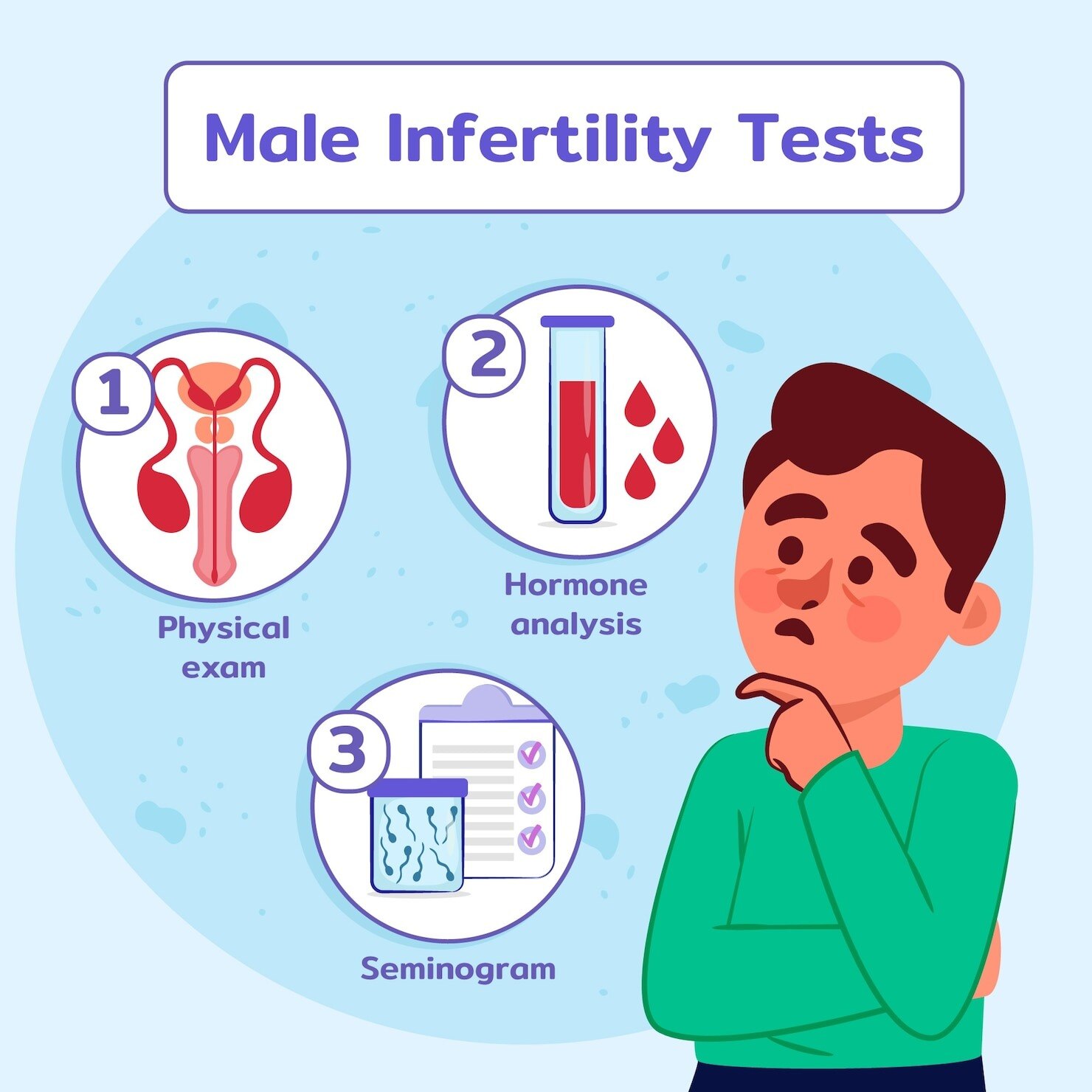
Male-factor infertility needs more than a semen report or a fertility work-up focused only on the woman. You will learn when both partners should seek care, what the male consultation and tests involve, and how a pregnancy doctor coordinates treatment with fertility, urology andrology, and genetics specialists.
Key takeaways
- Seek care after 12 months, or six months when the female partner is 35 or older.
- Book sooner for testicular problems, sexual difficulties, or prior chemotherapy.
- Review semen volume, sperm count, movement, and shape—not one number alone.
- Confirm an abnormal semen analysis before choosing further tests or treatment.
When should both partners seek fertility care?
Seek fertility care after 12 months of regular unprotected intercourse if the female partner is under 35, or after six months if she is 35 or older. Do not wait that long when either partner has a clear risk factor.
Seek an earlier consultation if there is:
- No menstrual periods, known endometriosis, or tubal disease
- Erectile or ejaculatory problems
- Previous chemotherapy, testicular injury, surgery, or childhood testicular illness
- Anabolic-steroid or testosterone use, suspected male-factor infertility, or a previous abnormal semen analysis
Both partners should begin evaluation at the same time. Treating only the woman can waste months when the male partner has a correctable or treatment-changing problem.
An infertility doctor in Hinjewadi can review conception history, previous pregnancies, medications, sexual function, infections, heat or toxin exposure, smoking, alcohol, and occupational risks while arranging semen testing and the appropriate referral.
A pregnancy doctor in Hinjewadi Wakad can coordinate the couple’s care rather than ordering a female-only work-up. The doctor combines semen findings with the female partner’s age, ovarian reserve, tubal status, and available treatment time, then refers the man to a reproductive urologist or andrologist when examination or testing requires specialist input.
Bring semen-analysis reports, medication lists, surgical records, and a clear timeline of attempts to conceive.
What happens during a male fertility consultation?
The appointment starts with a detailed history, not a prescription. A fertility specialist reviews both partners’ timelines and coordinates with a pregnancy doctor in Hinjewadi or Wakad for male infertility treatment. Male assessment should happen alongside the female partner’s evaluation, not after her tests or treatment have failed.
Expect questions about:
- How long you have tried to conceive, regularity of intercourse, and any previous pregnancies
- Erectile function, ejaculation, libido, and pain during sex
- Childhood undescended testis, mumps, genital infections, or testicular problems
- Testicular injury, groin surgery, hernia repair, or vasectomy
- Prescription medicines, testosterone injections, anabolic steroids, and “testosterone boosters”
- Smoking, alcohol, recreational drugs, high heat exposure, pesticides, solvents, and workplace risks
The examination checks testicular size and position, the epididymis, vas deferens, and signs of a palpable varicocele. An imaging-only varicocele does not automatically require treatment; the finding matters when infertility and abnormal semen results are also present.
A male fertility consultation in Wakad or Hinjewadi may lead to referral to a reproductive urologist, andrologist, or genetic counsellor.
Bring every previous semen-analysis report, medication and supplement list, surgical records, hormone results, and a clear conception history. Before the visit, note the last testosterone or steroid dose and avoid hiding “booster” products: external testosterone can suppress sperm production or stop it altogether.
How should you understand a semen analysis?
A semen analysis is a snapshot, not a verdict. Collect the entire ejaculate by masturbation in the laboratory’s sterile container after its specified abstinence interval; avoid lubricants and ordinary condoms because they can alter or trap sperm.
- Keep the container at the temperature and orientation the laboratory instructs.
- Record the collection time and deliver it within the stated window, commonly about one hour.
- Tell the laboratory if any portion was spilled, since the result may underestimate the total number.
If the first report is abnormal, repeat testing after about one month using the same preparation rules. Semen results vary between ejaculates, so one abnormal sample does not establish infertility.
WHO 2021 lower fifth-percentile reference values come from fertile men, not a pass-or-fail fertility test.
| Measure | Meaning | WHO 2021 reference |
|---|---|---|
| Volume | Total fluid ejaculated | 1.4 mL |
| Concentration | Sperm per millilitre | 16 million/mL |
| Total count | Sperm in the entire ejaculate | 39 million |
| Total motility | Moving sperm, progressive and non-progressive | 42% |
| Progressive motility | Sperm moving forward | 30% |
| Morphology | Normally shaped sperm | 4% |
| Vitality | Live sperm, including non-moving live cells | 54% |
Oligospermia means a low sperm concentration or total count; azoospermia means no sperm detected in the ejaculate. White blood cells above 1 million/mL can suggest inflammation or infection. DNA fragmentation is a separate test measuring sperm-DNA damage; it can be abnormal despite acceptable count, movement, or shape.
A fertility specialist can interpret these findings for male infertility treatment in Hinjewadi.
Which tests and treatments follow an abnormal result?
An abnormal semen analysis does not automatically mean ICSI. The next step depends on sperm production, obstruction, symptoms, the female partner’s findings, and available treatment time.
| Test or treatment | What it addresses | When it applies |
|---|---|---|
| Hormone testing | FSH, morning testosterone, LH and prolactin | Low concentration, small testes, low libido, erectile problems or suspected endocrine disease |
| Genetic testing | Karyotype, Y-chromosome microdeletions or CFTR evaluation | Azoospermia, severe oligospermia, primary testicular failure or absent vas deferens |
| Imaging | Scrotal ultrasound or targeted duct imaging | A palpable varicocele, testicular abnormality or suspected obstruction; it is not routine for every abnormal report |
| Urology referral | Surgical and reproductive-male assessment | Azoospermia, obstruction, varicocele, testicular mass or a need for sperm retrieval |
| Sperm retrieval | Obtains sperm from the epididymis or testis | Obstructive azoospermia or selected cases of non-obstructive azoospermia |
| IUI | Places prepared sperm inside the uterus | Adequate motile sperm remain and the female partner’s tubes and treatment window support it |
| IVF or ICSI | Fertilises eggs in the laboratory | IVF suits some sperm deficits; ICSI injects one sperm into each egg when sperm numbers or movement are extremely poor |
ICSI can bypass a severe sperm shortage, but it does not repair the cause and is not required for every abnormal result. Testosterone replacement is also not fertility treatment: external testosterone suppresses FSH and LH, reducing or stopping sperm production.
Disclose testosterone, anabolic steroids and boosters to an infertility doctor in Hinjewadi; specialist-directed alternatives may suit selected men. Male infertility treatment in Hinjewadi may therefore include endocrine care, surgery or coordinated IUI, IVF or ICSI.
How does the pregnancy doctor turn findings into a couple’s plan?
An abnormal semen result does not decide treatment by itself; the couple’s plan depends on female partner age, ovarian reserve, tubal status, and time available. A 32-year-old with open tubes and adequate reserve may have time to treat a correctable male cause, while a 39-year-old with diminished reserve may need a faster route.
A pregnancy doctor in Hinjewadi Wakad who coordinates male infertility treatment compares both partners’ findings in one discussion. During a male fertility consultation in Wakad, bring semen reports, medication details and the conception timeline; the doctor can coordinate a reproductive urologist, andrologist, genetic counsellor or female-fertility assessment instead of repeating isolated tests.
The plan usually falls into one of these paths:
- Treat the cause first, such as endocrine disease, obstruction or a selected varicocele, when sperm production and the female partner’s time allow it.
- Use IUI when enough motile sperm are available, the tubes are open and the female partner’s ovarian reserve supports a limited number of attempts.
- Move to IVF, with ICSI when very few usable sperm are available or previous fertilisation failed, when age, reserve, tubal disease or prolonged infertility makes delay costly.
Conceive IVF-IVF Centre, IVF Clinic in Hinjewadi, Wakad, Pune can provide the coordinated review needed to align male findings with the female partner’s treatment timeline. That approach avoids treating one partner in isolation or using ICSI automatically for every abnormal semen analysis.
Related services
Male Infertility Treatment Centre in Nigdi,Akurdi,Chinchwad,PCMC,Pune Male Infertility Treatment Centre in Nigdi,Akurdi,Chinchwad,PCMC,Pune Conceive IVF,Fertility And Test Tube Baby Center is the Best Male Infertility Treatment Centre in Nigdi,Akurdi,Chinchwad,PCMC and Pune. |
Male Infertility Treatment Centre Male Infertility Treatment Centre in Hinjewadi,Wakad,PCMC,Pune Conceive IVF,Fertility And Test Tube Baby Center is the Best Male Infertility Treatment Centre in Hinjewadi,Maruji,Mahalunge,Kasarsai,Nerhe,PCMC and... View service → |
Frequently asked questions
When should both partners seek fertility care?
Seek care after 12 months of regular unprotected intercourse when the female partner is under 35, or after six months when she is 35 or older. Go sooner after a clear fertility risk factor, such as testicular disease, chemotherapy, or sexual difficulty.
What happens during a male fertility consultation?
The doctor reviews pregnancy history, intercourse, medications, illnesses, surgeries, lifestyle, and reproductive risk factors, then performs a focused examination and orders a semen analysis.
How should you understand a semen analysis?
Review semen volume, sperm concentration, total sperm number, motility, morphology, and other laboratory findings together. A single abnormal result does not establish the cause, so the doctor may recommend a repeat sample.
Which tests and treatments follow an abnormal semen analysis?
Depending on the pattern and medical history, follow-up can include hormone tests, scrotal ultrasound, urine testing, or genetic testing. Treatment may address varicocele, infection, hormone problems, ejaculation issues, or use IUI, IVF, or ICSI.
How does the pregnancy doctor turn findings into a couple’s plan?
The doctor combines both partners’ age, test results, fertility goals, time trying to conceive, and treatment preferences to set next steps, such as timed intercourse, treating a reversible cause, IUI, IVF, or ICSI.
Related services
Male Infertility Treatment Centre in Bhosari Male Infertility Treatment Centre in Bhosari,PCMC,Pune Conceive IVF,Fertility And Test Tube Baby Center is the Best Male Infertility Treatment Centre in Bhosari, Dighi, Charholi, Alandi, PCMC and Pune. View service → |
Male Infertility Treatment Centre Male Infertility Treatment Centre in Pimpri,Bhosari,PCMC,Pune Conceive IVF,Fertility And Test Tube Baby Center is the Best Male Infertility Treatment Centre in Pimpri,Bhosari,Alandi,Charholi,PCMC and Pune. |
Male Infertility Treatment Centre inRavet,Punawale,Somatane Phata,PCMC,Pune Conceive IVF,Fertility And Test Tube Baby Center is the Best Male Infertility Treatment Centre in Ravet,Punawale,Kiwale,Somatane Phata,Gahunje,PCMC... |
Male Infertility Treatment Centre in Moshi Male Infertility Treatment Centre in Moshi,PCMC,Pune Conceive IVF,Fertility And Test Tube Baby Center is the Best Male Infertility Treatment Centre in Moshi, Chakan, PCMC and Pune. View service → |