Waiting too long for pregnancy can create uncertainty, but the right time to seek medical advice depends on age, cycle pattern, medical history, and warning symptoms. By the end, you will know when to book an evaluation, which clinician to choose, what testing involves, and how to compare fertility clinics in Nigdi.
Key takeaways
- Seek evaluation after 12 months under 35, six months at 35 to 39, or at age 40.
- Book sooner for irregular periods, endometriosis, pelvic infection, or repeated miscarriages.
- Ask which diagnosis each fertility test investigates before agreeing to treatment.
- Compare clinic doctors, laboratory support, counselling, treatment options, and follow-up care.
Know When Waiting Has Gone on Long Enough
The usual timeline is 12 months under 35, 6 months at age 35 to 39, and a female infertility evaluation at age 40. If pregnancy has not occurred, these thresholds apply after regular, unprotected intercourse: every 1 to 2 days in the fertile window or two to three times weekly throughout the cycle.
Book sooner—and learn when to see a pregnancy doctor—if any of these apply:
- Absent or highly irregular periods, suspected PCOS, endometriosis, or severe pelvic pain.
- Previous pelvic inflammatory disease, an ectopic pregnancy, blocked tubes, or pelvic or ovarian surgery.
- Previous chemotherapy or radiation, diminished ovarian reserve, or a partner with a known fertility problem.
- Two clinical pregnancy losses. Recurrent pregnancy loss warrants specialist assessment even when conception happens quickly.
Seek prompt gynecological care for severe pelvic pain, abnormal bleeding, or very heavy periods. With a positive pregnancy test, one-sided pain, shoulder-tip pain, dizziness, or fainting may indicate an ectopic pregnancy and needs urgent care. A regular cycle does not prove normal fertility; egg number and egg-related chromosomal competence decline with age.
Choose the Right Clinician and Prepare for the First Visit
Start with a gynecologist for irregular bleeding, pelvic pain, suspected PCOS, endometriosis, or preconception advice. The pregnancy doctor versus gynecologist decision depends on the problem you need assessed.
| Clinician | Main focus | Best starting point |
|---|---|---|
| Gynecologist | General reproductive and pelvic health | Irregular periods, pain, PCOS, endometriosis, or preconception care |
| Reproductive endocrinologist | Ovulation, ovarian reserve, tubal factors, and infertility treatment | Difficulty conceiving or complex hormonal and reproductive concerns |
| IVF specialist | Assisted reproduction and IVF planning | When IVF or another advanced treatment is being considered |
Seeing an IVF specialist does not commit you to IVF. Your results may instead support timed intercourse, ovulation treatment, surgery for selected conditions, or intrauterine insemination.
At the first visit, expect questions about cycle length, bleeding, ovulation-test results, pregnancies and miscarriages, pelvic infections, operations, medicines, supplements, sexual frequency, pain during intercourse, and previous treatment. The clinician may perform a pelvic examination when indicated and arrange a transvaginal ultrasound.
Know what to bring to fertility appointment preparation:
- Menstrual dates and ovulation-test results
- Pregnancy and miscarriage records
- Medication and supplement lists
- Operative reports
- Previous ultrasound and laboratory reports
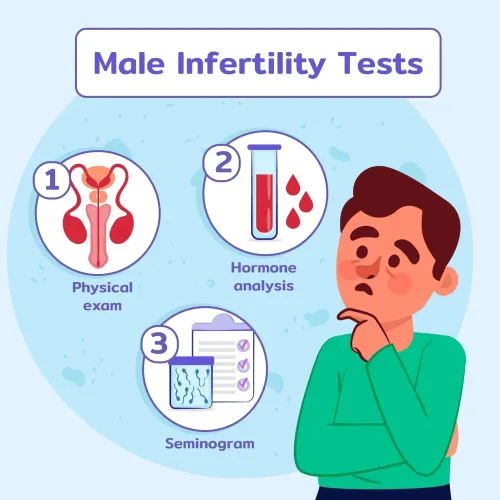
Testing should begin for both partners. A semen analysis is part of the initial evaluation, rather than assuming the woman is the sole source of infertility. Ask how results will be reviewed and when you will receive a treatment plan.
Understand Which Fertility Tests Answer Which Questions
Each female infertility test should answer a defined question; a normal result does not make every cause disappear.
| Test | Question answered | Important limit |
|---|---|---|
| Pregnancy test | Is a pregnancy already present before treatment? | It does not explain infertility. |
| TSH and prolactin | Could thyroid disease or high prolactin disrupt ovulation? | They do not assess tubes or egg supply. |
| Cycle history, urine tests, ultrasound monitoring, or progesterone | Is ovulation occurring? | A progesterone test is used when indicated; regular cycles often already suggest ovulation. |
| AMH fertility test, antral follicle count, and FSH and estradiol testing on day 2 to 5 of the cycle | What is the estimated ovarian reserve and likely response to stimulation? | AMH alone cannot prove that natural conception is impossible or guarantee IVF success. |
| Transvaginal ultrasound | Are there fibroids, polyps, adenomyosis, cysts, or polycystic-appearing ovaries? | It cannot confirm open tubes or exclude endometriosis. |
| HSG or HyCoSy | Are the fallopian tubes open? | These tests do not measure egg quality or guarantee pregnancy. |
| Laparoscopy | Is there endometriosis, adhesions, or other pelvic disease? | It is reserved for suggestive symptoms or history, or inconclusive less-invasive tests. |
Ask why each test is needed and how the result will change treatment. Routine immune panels, thrombophilia testing, post-coital testing, and endometrial biopsy are not standard first-line female infertility tests without a specific indication.
Match Treatment to the Diagnosis Instead of Starting with IVF
After evaluation, female infertility treatment options should match the cause, not default to IVF. Absent ovulation from PCOS, thyroid disease, or high prolactin may improve after the disorder is treated and monitored ovulation induction is prescribed.
| Option | When it applies | Main limitation or trade-off |
|---|---|---|
| Timed intercourse | Ovulation is regular, tubes are open, and semen results are usable | Requires accurate timing and offers no solution for blocked tubes |
| IUI | At least one tube is open and the clinical situation supports prepared sperm placed inside the uterus | Not suitable for two blocked tubes or severe male-factor infertility |
| Surgery | Selected fibroids, polyps, adhesions, endometriosis, or tubal disease | Procedure risks and recovery; correcting anatomy is not always the best route |
| IVF | Blocked tubes, severe sperm problems, some reduced ovarian reserve, or failed simpler treatment | More medication, procedures, monitoring, cost, and emotional strain |
The choice between IUI versus IVF depends on age, ovarian reserve, tubal status, semen results, ovulation, and previous treatment. Every route can involve repeated visits, blood tests, ultrasound scans, side effects, discomfort, time away from work, and fertility treatment risks and monitoring.
Do not keep using ovulation kits without a diagnosis or take fertility medicines without supervision. Ask about:
- Folic acid and avoiding tobacco or recreational drugs
- Managing diabetes, thyroid disease, and hypertension
- The number of visits, cancellation rules, and what happens if treatment fails
Irregular periods or age-related concerns make delay unsafe; book an evaluation rather than self-treating.
Compare Fertility Clinics in Nigdi Before Booking
Before paying for a package, verify that the fertility clinic in Nigdi suits your practical needs, not just its advertised success claims. Use this fertility clinic appointment checklist:
| Clinic feature | What to verify | Why it matters |
|---|---|---|
| Location and access | Nigdi address, appointment availability, and monitoring hours | Frequent visits become difficult if travel or scheduling is unclear |
| Medical team | Doctor credentials and who performs transvaginal scans | You know who examines you and reviews decisions |
| Testing and laboratory | On-site laboratory access, HSG or HyCoSy arrangements, and testing for both partners | A semen analysis should happen alongside female evaluation |
| Treatment pathway | Options before IVF, including timed intercourse, ovulation induction, surgery, or IUI | Normal initial tests do not automatically justify IVF |
| Follow-up and safety | Result-review time, emergency care for severe pain or heavy bleeding, and cancelled-cycle policy | Delays and unclear escalation can affect safety and cost |
Ask for a written price breakdown covering consultations, blood tests, ultrasound monitoring, medicines, HSG or HyCoSy, IUI or IVF, anaesthesia, and cancellation rules. Ask how many monitoring visits are likely and whether insurance covers consultations, diagnostic tests, or medicines; request every exclusion in writing.
When deciding how to choose an IVF clinic, ask whether the clinician explains each test, alternative treatments, risks, and the reason for proceeding. Conceive IVF-IVF Centre, IVF Clinic in Hinjewadi, Wakad, Pune is one clinic someone near Nigdi can assess against these questions.
An appointment should produce an informed diagnosis and plan, not an automatic commitment to IVF.
Related service
Female Infertility Treatment Centre in Nigdi,Akurdi,Chinchwad,PCMC,Pune Female Infertility Treatment Centre in Nigdi,Akurdi,Chinchwad,PCMC,Pune Conceive IVF,Fertility And Test Tube Baby Center is the Best Female Infertility Treatment Centre in Nigdi,Akurdi,Chinchwad,PCMC and Pune. |
Frequently asked questions
When should you see a pregnancy doctor for female infertility?
Seek an evaluation after 12 months of regular unprotected intercourse if you are under 35, after six months from age 35 to 39, or at age 40. Book sooner for irregular periods, endometriosis, pelvic infection, repeated miscarriages, or other known fertility concerns.
How should you prepare for your first fertility appointment?
Bring your menstrual-cycle dates, previous pregnancy records, operation reports, medication list, test results, and details of how long you have tried to conceive. Write down your questions and ask whether your partner needs a semen analysis.
What fertility tests answer the main infertility questions?
Ovulation tests assess whether an egg is being released; blood tests examine hormones; ultrasound checks the uterus and ovaries; tubal-patency tests assess whether the fallopian tubes are open; and semen analysis evaluates sperm count, movement, and shape.
Should you start with IVF for female infertility?
No. Treatment should match the diagnosis. Depending on the findings, care may involve timing intercourse, ovulation medicines, treatment for endometriosis or fibroids, intrauterine insemination, surgery, or IVF.
How can you compare fertility clinics in Nigdi?
Compare the clinician’s experience, diagnostic process, laboratory arrangements, counselling, treatment choices, written costs, consent process, appointment access, and follow-up plan before booking.