A fertility clinic and a maternity hospital may operate in the same care pathway, but they do not provide the same services. You will be able to identify female fertility warning signs, know which tests assess both partners, match treatment to the diagnosis, and check whether a centre can support you through pregnancy and urgent care.
Key takeaways
- Choose a fertility clinic for conception problems; choose maternity care after pregnancy begins.
- Seek evaluation for irregular periods, pelvic pain, suspected blocked tubes, or delayed conception.
- A first work-up checks ovulation, ovarian reserve, semen, fallopian tubes, and the uterus.
- Compare licensing, laboratory standards, emergency access, counselling, and treatment transparency.
Fertility Clinic or Maternity Hospital: Which Care Do You Need?
A fertility clinic investigates why conception has not occurred and treats causes before or around conception. It assesses both partners in parallel, including semen analysis, ovulation, ovarian reserve, fallopian tubes and the uterus. Treatment may involve timed intercourse, medication, IUI or IVF.
| Care setting | Main purpose | What you receive |
|---|---|---|
| Fertility clinic | Achieve pregnancy | Fertility assessment, counselling, ovulation treatment, IUI or IVF |
| Maternity hospital | Support an established pregnancy and birth | Antenatal care, labour monitoring, delivery services Bhosari and postnatal care |
| Maternity centre near Bhosari | Depends on its facilities | Confirm whether it provides pregnancy follow-up, 24-hour labour care, newborn support and postnatal review |
A maternity hospital takes over after pregnancy is established, although some fertility clinics coordinate early scans and refer you for antenatal care. Antenatal care includes blood tests, ultrasound examinations, blood-pressure checks, diabetes screening and monitoring the baby’s growth.
Delivery care covers vaginal birth, caesarean birth and emergency obstetric treatment; postnatal care follows the mother and newborn after birth.
Ask directly whether the chosen maternity centre near Bhosari has an obstetrician on site, a newborn-care unit and emergency caesarean capability. Do not assume that a centre offering fertility treatment also provides delivery or postnatal care.
After a positive test following fertility treatment, severe one-sided abdominal pain, shoulder-tip pain, fainting or heavy bleeding needs urgent medical assessment. These symptoms can indicate ectopic pregnancy, including after IVF.
Female Conditions and Warning Signs That Deserve Evaluation
Irregular, very long or absent periods deserve evaluation because they often signal PCOS or other ovulation disorders. Arrange care sooner for severe period pain, persistent pelvic pain, unusual bleeding, repeated miscarriage, or nipple discharge unrelated to breastfeeding.
A fertility assessment also matters after 12 months of trying if you are under 35, after six months at 35–39, or promptly from age 40.
| Condition or warning sign | What it may indicate | Why evaluation matters |
|---|---|---|
| PCOS, infrequent periods or no periods | Ovulation disorders | Irregular ovulation can make conception difficult; letrozole is usually first-line for PCOS-related anovulation when no other factor exists |
| Severe period pain or deep pelvic pain | Endometriosis or adenomyosis | Endometriosis treatment decisions must consider pain, ovarian reserve and prior surgery; surgery is not automatically needed before IVF |
| Previous pelvic infection, ectopic pregnancy or pelvic surgery | Blocked or damaged fallopian tubes | Hysterosalpingography or HyCoSy can assess tubal patency |
| Low ovarian reserve or ovarian surgery | Diminished ovarian reserve or premature ovarian insufficiency | Earlier assessment can clarify remaining reproductive options |
| Heavy bleeding or pressure symptoms | Fibroids, polyps or other uterine problems | Imaging can identify problems affecting the uterine cavity |
| Two or more miscarriages | Recurrent pregnancy loss | A targeted investigation can identify treatable causes |
If you searched endometriosis Bhosari, choose care that evaluates both partners in parallel. A semen analysis remains essential even when PCOS, endometriosis or blocked tubes appears to explain infertility.
When to Seek Care and What the First Fertility Work-Up Includes
Arrange a fertility evaluation after 12 months of regular unprotected intercourse if you are under 35, after 6 months if you are 35 to 39, and promptly from age 40.
Seek care sooner at any age for irregular or absent periods, suspected endometriosis or tubal disease, previous pelvic infection or surgery, repeated miscarriages, or a known male-factor concern.
| Age or situation | When to seek evaluation | Reason |
|---|---|---|
| Under 35 | After 12 months of trying | Meets the usual infertility definition |
| 35–39 | After 6 months of trying | Fertility declines with age |
| 40 or older | Promptly | Do not delay assessment |
| Known condition or warning sign | As soon as identified | Ovulation, tubal or uterine problems need targeted evaluation |
Both partners should be assessed in parallel. Expect a detailed history of cycle timing, pregnancies, miscarriages, pain, operations, medications and sexual frequency, followed by a physical examination when indicated.
The initial work-up commonly includes:
- Semen analysis for the male partner, even when you have PCOS, endometriosis or suspected blocked tubes.
- Transvaginal ultrasound to assess the uterus, ovaries, antral follicles, fibroids, endometriosis-related changes and ovarian cysts.
- An AMH test as one measure of ovarian reserve; it does not prove whether you can conceive naturally.
- Ovulation assessment, with cycle tracking and selected blood tests such as progesterone, thyroid-stimulating hormone or prolactin when indicated.
- Tubal testing with hysterosalpingography or HyCoSy.
Diagnostic laparoscopy and hysteroscopy are targeted tests, not automatic first-line screening. After a positive pregnancy test, severe one-sided pain, shoulder-tip pain, fainting or heavy bleeding requires urgent assessment for ectopic pregnancy.
How Doctors Match Treatment to the Cause
Age, ovulation, tubal patency and semen quality are assessed together; treating only the apparent female problem can delay effective care. A semen analysis belongs in the initial work-up even when PCOS, endometriosis or blocked tubes is already known. AMH and antral follicle count mainly predict ovarian response and egg numbers, not natural conception.
| Option | What it means | When it applies |
|---|---|---|
| Timed intercourse | Sex planned around confirmed ovulation | Ovulation occurs, at least one tube is open, and semen results are adequate |
| Medication with ovulation induction | Medicines help follicles develop and release an egg | Irregular or absent ovulation without a major tubal or sperm factor; letrozole for PCOS is usually first-line, while clomiphene is another option |
| IUI | Prepared sperm is placed inside the uterus around ovulation | At least one fallopian tube is open, ovulation is achievable, and sperm count and movement are suitable; this is the treatment people may find by searching intrauterine insemination Pune |
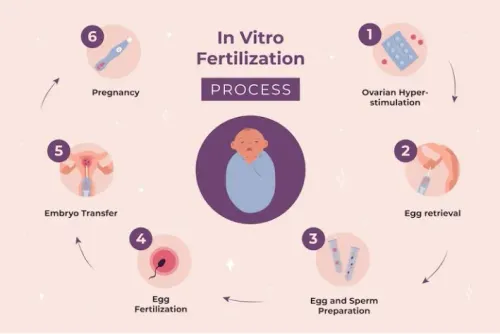
| IVF | Eggs are collected, fertilised in the laboratory and embryos are transferred | Both tubes are blocked, sperm impairment is significant, ovarian reserve or age makes time important, or other treatments have not worked |
At age 35 to 39, doctors weigh time and diagnosis more heavily; at 40 or older, they often discuss IVF sooner. Ask how IVF results are reported: live birth per treatment cycle or egg retrieval is more useful than a positive pregnancy-test rate, and results vary with age, diagnosis, ovarian response and embryo quality.
A low AMH alone does not rule out IVF.
How to Choose a Safe Centre Near Bhosari
Ask to see the centre’s registration under the Assisted Reproductive Technology Regulation Act 2021; “IVF clinic registration India” should be verifiable, not just stated in advertising. Confirm who handles emergencies, ultrasound scans, laboratory work, embryo-transfer follow-up and maternity referrals outside office hours.
| Check | Fertility clinic | Maternity hospital |
|---|---|---|
| Main service | Ovulation treatment, IUI and IVF | Antenatal visits, delivery and postnatal care |
| Emergency cover | Ovarian stimulation complications and early-pregnancy assessment | Labour, bleeding, hypertension and newborn emergencies |
| Confirm before booking | Embryology laboratory, counselling and transfer follow-up | 24-hour obstetrician, anaesthetist, operating theatre and newborn support |
Compare results using live birth per treatment cycle or egg retrieval, not only positive pregnancy-test rates. Ask for the denominator, age groups and whether the figures include donor cycles; a pregnancy rate without these details cannot be compared fairly.
Also ask about the centre’s transfer policy. Elective single embryo transfer lowers twin and higher-order pregnancy risks, while transferring several embryos raises the chance of preterm birth and low birth weight.
- Confirm that both partners can receive parallel assessment, including semen analysis.
- Ask whether proposed endometrioma surgery could reduce ovarian reserve and why it is needed.
- Keep the emergency number. After a positive test, severe one-sided pain, shoulder-tip pain, fainting or heavy bleeding are ectopic pregnancy warning signs requiring urgent assessment.
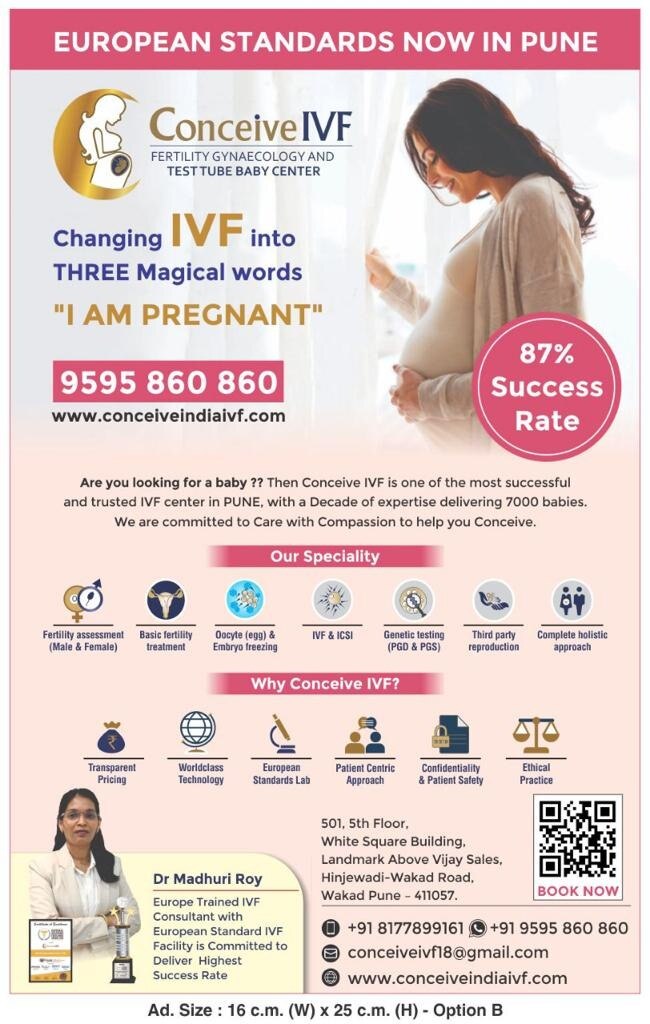
Conceive IVF-IVF Centre, IVF Clinic in Hinjewadi, Wakad, Pune should be assessed by these same checks, including whether its location matches your need for maternity and emergency care.
Frequently asked questions
Do you need a fertility clinic or a maternity hospital?
Choose a fertility clinic when you need investigation or treatment for difficulty conceiving. A maternity hospital provides antenatal, delivery, and postnatal care after pregnancy begins.
Which female fertility conditions deserve evaluation?
Evaluation is appropriate for irregular or absent periods, suspected ovulation problems, endometriosis, pelvic pain, previous pelvic infection, fibroids, repeated pregnancy loss, or suspected blocked fallopian tubes.
When should you seek fertility care?
Seek care after 12 months of regular unprotected intercourse if you are under 35, after 6 months if you are 35 or older, or sooner for irregular periods, known reproductive conditions, or prior fertility treatment.
What happens during the first fertility work-up?
Doctors review medical and menstrual history, assess ovulation and ovarian reserve, arrange semen analysis, and check the fallopian tubes and uterus with appropriate tests.
How do doctors match fertility treatment to the cause?
Treatment can include timed intercourse, ovulation medication, surgery for selected conditions, IUI, or IVF. The choice depends on the diagnosis, test results, age, duration of infertility, and previous treatment.